
What Is the 10/20/30/40 Rule When Making Concrete?
What Is the 10/20/30/40 Rule When Making Concrete?
If you’ve been researching concrete installation, you may have come across something called the “10/20/30/40 rule.” It sounds technical, but it’s actually a simple way to understand how concrete mixtures are proportioned for strength and durability.
Whether you're planning a driveway, patio, or foundation in Kansas City, understanding how concrete is mixed helps you make smarter decisions when comparing estimates from concrete contractors kansas city homeowners trust.
What You’ll Learn in This Guide
- What the 10/20/30/40 rule refers to in concrete mixing
- Why aggregate balance matters for long-term durability
- How improper mix ratios lead to cracking
- How Kansas City weather impacts concrete strength
- When professional mixing and pouring matters most
What Is the 10/20/30/40 Rule in Concrete?
The 10/20/30/40 rule refers to the approximate percentage breakdown of materials in a properly balanced concrete mix. While exact ratios vary by project, the rule represents how cement, sand, gravel (aggregate), and water proportionally contribute to a strong, workable mixture.
In simple terms, concrete is not just “cement.” It’s a carefully engineered combination of materials that must balance strength, flexibility, and curing performance.
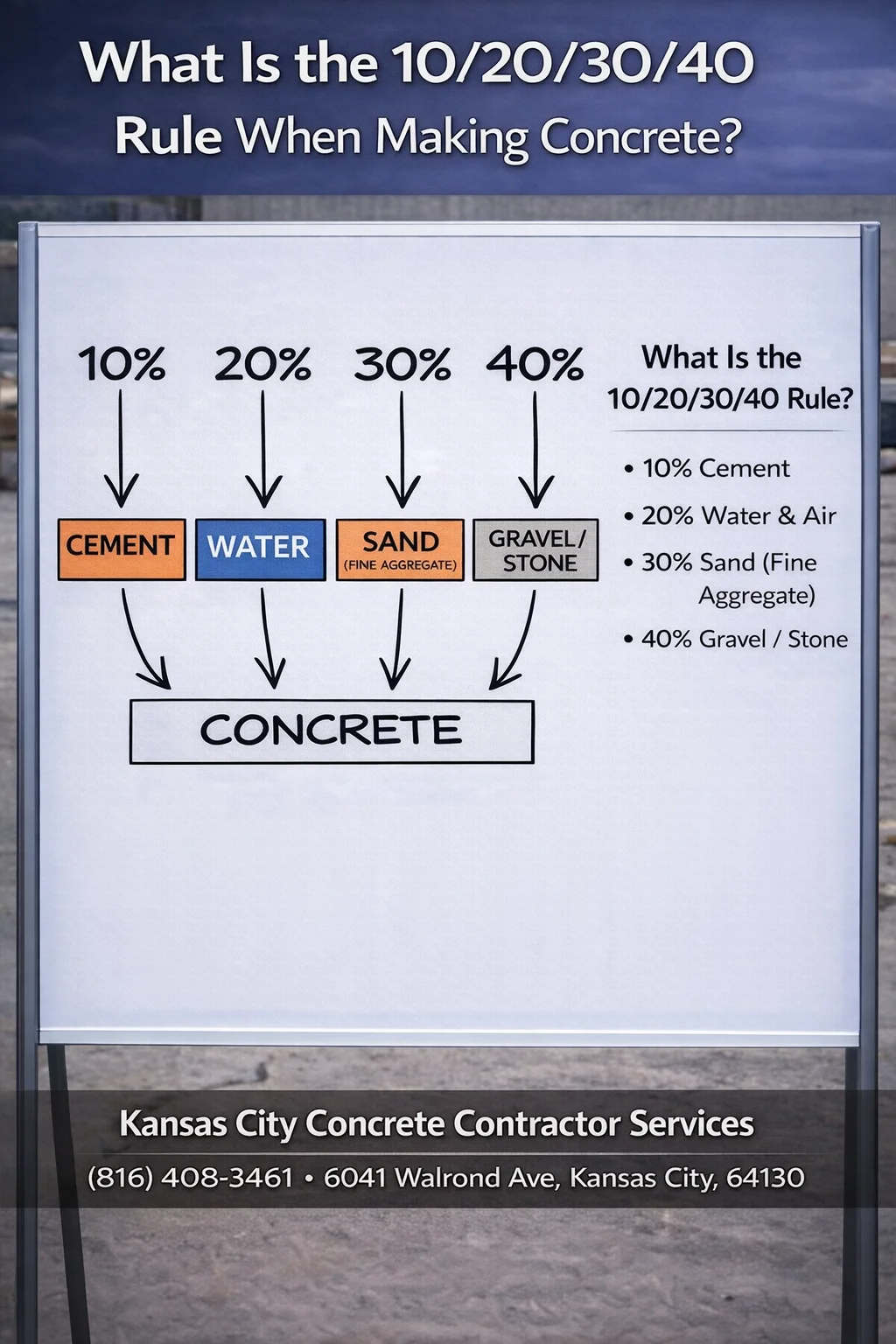
Proper aggregate balance (10/20/30/40 rule) plays a major role in concrete durability.
Breaking Down the 10/20/30/40 Rule
10% Cement
Cement is the binding ingredient that holds everything together. Too little reduces strength. Too much increases shrinkage and cracking risk.
20% Water
Water activates the cement through hydration. However, excessive water weakens concrete. This is one of the most common causes of surface deterioration and early cracking.
30% Sand (Fine Aggregate)
Sand fills gaps between larger stones, helping create a dense, uniform mixture.
40% Gravel (Coarse Aggregate)
Gravel provides structural bulk and compressive strength. In Kansas City driveways and slabs, proper aggregate sizing is critical to prevent settling and surface cracking.
Why Mix Ratios Matter in Kansas City
Kansas City’s freeze–thaw cycles put serious stress on concrete surfaces. When moisture seeps into porous or improperly mixed slabs, expansion during winter freezing can cause cracking and spalling.
That’s why experienced concrete contractors carefully control water-to-cement ratios and ensure proper air entrainment when needed.
How the 10/20/30/40 Rule Applies to Real Projects
For residential driveways, patios, sidewalks, and foundations, the mix must match load requirements. A patio may require a different strength rating than a driveway that supports vehicle weight.
Professional concrete contractors near me searches often lead homeowners to specialists who understand these differences.
Organizations like the American Concrete Institute (ACI) publish technical standards that guide mix design and curing practices for long-term durability.
Common Mistakes When Mixing Concrete
- Adding excess water
- Skipping proper curing time
- Poor subgrade preparation
- Incorrect aggregate balance
- Pouring during extreme temperature swings
Improper mixing may not show problems immediately. Cracks, scaling, and surface flaking often appear months later.
Mini Case Example: Kansas City Driveway Replacement
A homeowner in Kansas City recently replaced an aging driveway that had cracked heavily after just five winters. Investigation revealed excess water had been added during the original pour, weakening the slab.
The replacement project followed proper mix proportions and curing procedures. Three winters later, the slab remains stable without surface damage — a direct result of correct mix balance and installation technique.
Frequently Asked Questions for Concrete in Kansas City
Is the 10/20/30/40 rule an exact formula?
No. It’s a simplified guideline to explain proportional balance. Actual mix ratios vary depending on structural requirements and environmental conditions.
Why can’t you just add more cement for strength?
Too much cement increases shrinkage and cracking risk. Strength depends on balanced proportions, not just cement quantity.
How long does concrete take to cure?
Concrete sets within 24–48 hours but continues curing for about 28 days to reach full strength.
Does Kansas City weather affect curing?
Yes. Temperature swings and moisture levels can significantly affect curing time and final durability.
Planning a Concrete Project in Kansas City?
If you're planning a driveway, patio, or slab installation, working with experienced concrete contractors kansas city ensures your mix design matches your soil conditions and local climate.
Before committing, review project details, ask about mix ratios, and verify curing plans. A properly balanced concrete mix makes the difference between a slab that lasts five years — and one that lasts decades.